ISC-FICCI Sanitation Awards 2026: A Simple Guide to Complete Your Nomination
Article Published On: 08 May 2026
Blog Writer:  Hussain Rangwala,
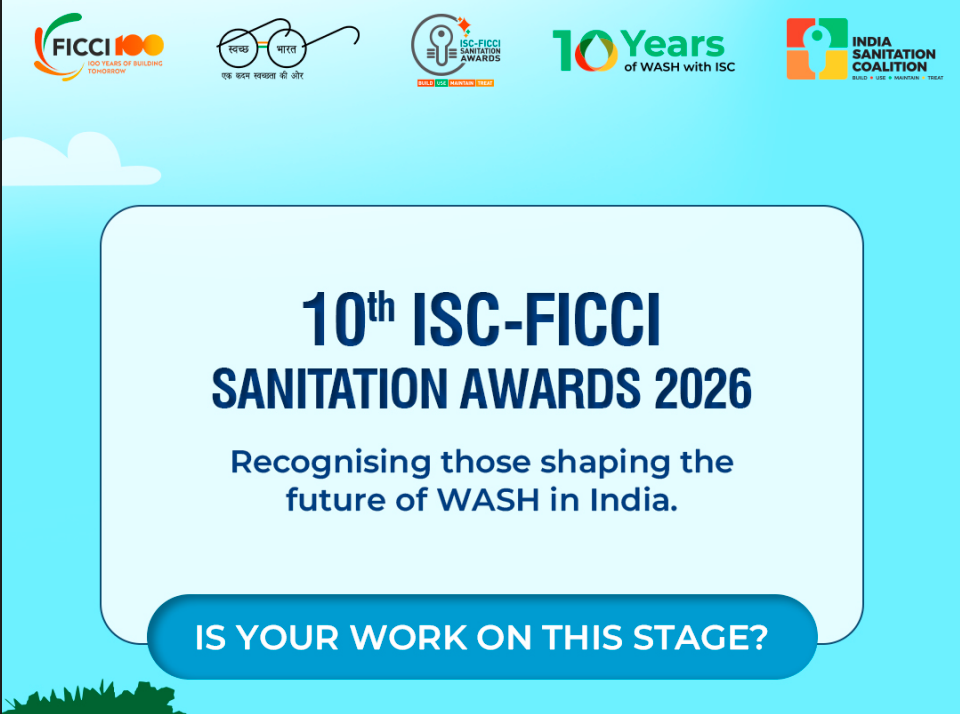 As India advances toward its vision of Viksit Bharat, the importance of safe, sustainable, and inclusive water, sanitation, and hygiene (WASH) systems has never been more critical. At the forefront of recognising leadership and innovation in this space are the ISC-FICCI Sanitation Awards—now in their 10th edition.
Since their inception in 2017, the awards have emerged as one of India’s most credible platforms for honouring excellence across sanitation, waste management, and hygiene. Over the years, they have celebrated a diverse range of changemakers—grassroots organisations, urban local bodies, private sector leaders, and individuals—who are driving measurable impact on the ground. Supported by the Ministry of Housing and Urban Affairs (MoHUA) and the Department of Drinking Water and Sanitation under the Ministry of Jal Shakti, the awards go beyond recognition by offering national visibility and opportunities for collaboration and knowledge exchange.
The ISC-FICCI Sanitation Awards are closely aligned with India’s flagship missions, including Swachh Bharat Abhiyan, Atmanirbhar Bharat, and Har Ghar Jal. They spotlight initiatives that contribute meaningfully to these national priorities—whether through infrastructure development, behaviour change, service delivery, or innovation. For awardees, the recognition often serves as a catalyst, opening doors to strategic partnerships, scaling opportunities, and access to funding.
Complementing this platform is the Rashid Kidwai WASH Finance Awards, which focus on a critical but often under-recognised dimension of the sector: financing. While progress in WASH has accelerated in recent years, access to finance continues to be a key bottleneck. Traditional financial systems have typically viewed the sector as high-risk with limited returns, slowing the flow of capital into essential services like sanitation and water management.
However, this narrative is steadily changing. A new ecosystem of banks, development finance institutions, NBFCs, impact investors, and philanthropic organisations is stepping in to bridge this gap. From funding large-scale wastewater infrastructure to enabling women-led sanitation enterprises, these actors are redefining how capital can drive sustainable and inclusive WASH outcomes. The Rashid Kidwai WASH Finance Awards recognise and celebrate these efforts—highlighting innovative, scalable, and replicable financing models while encouraging greater mainstream investment in the sector.
Together, the ISC-FICCI Sanitation Awards and the Rashid Kidwai WASH Finance Awards present a holistic view of the WASH ecosystem—honouring both implementation excellence and the financial systems that enable it. They underscore a simple but powerful idea: sustainable impact in WASH requires not just strong execution, but also robust and innovative financing.
Past Awardees
Over the years, the ISC-FICCI Sanitation Awards have recognised and elevated several pioneering organisations and changemakers who are redefining India’s WASH landscape. Past awardees such as Genrobotics, creators of the robotic manhole cleaning and inspection device Bandicoot, have demonstrated how technology can transform sanitation worker safety by eliminating human contact with hazardous sewer waste. Since receiving recognition, the company has continued to gain national and global visibility, with its founders recently being featured in the Forbes Asia 30 Under 30 list under the Industry, Manufacturing & Energy category.
Similarly, PadCare Labs was recognised for addressing the critical gap in menstrual hygiene management through innovative sanitary waste solutions. The startup, supported by the Infosys Foundation under the Aarohan initiative, has since gained significant momentum in the sector. Their growing recognition includes being featured in Forbes 30 Under 30 India and securing investment on Shark Tank India, further validating the role of innovation in advancing WASH outcomes.
The awards have also spotlighted the growing leadership of women in sanitation and waste management. Over the years, the platform has received enthusiastic participation from women changemakers, including a strong representation of women Gram Pradhans and grassroots leaders. A notable example is Aspiya Banu, recipient of the Women Changemaker in Sanitation award, whose work has delivered measurable improvements in rural waste management—including cleaner surroundings, household-level wet waste management, a 90% increase in dry waste segregation, reduced waste sent to landfill, and improved livelihoods for waste workers. Alongside her, Priyanka Tiwari, Gram Pradhan of Rajpur Gram Panchayat in Uttar Pradesh, stands out as another inspiring past awardee. She has been a catalyst for positive change in her community, working tirelessly to transform mindsets and behaviours around waste management, plastic use, hygiene, and sanitation—particularly among women and children. Her forward-looking initiatives, including plastic buyback policies, the installation of plastic banks, and portable handwashing stations, have significantly strengthened plastic waste management and hygiene practices in her village. With a vision to make Rajpur a plastic-free village, her efforts reflect a strong commitment to inclusivity, gender equality, and community engagement—making her work a compelling example of grassroots leadership driving sustainable change.
Other past winners continue to showcase how innovation and sustainability can go hand in hand. Spruce Up, recognised for its contactless cleaning machine JATAYU, is strengthening sanitation worker safety and improving waste management efficiency, while its founders were also featured in the Forbes 30 Under 30 Asia list. Himalayan Hemp Industries, led by awardee Sonam Ratubha Sodha, introduced the world’s first lab-validated cannabis hemp sanitary pads—an innovation that combines menstrual hygiene, environmental sustainability, and rural economic empowerment.
The awards have also honoured large-scale infrastructure innovations by Zinc India Foundation, that pioneered Udaipur’s first Sewage Treatment Plant (STP) under a Public-Private Partnership model with an investment of over ?300 crore. With a treatment capacity of 60 MLD using advanced MBBR and SBR technologies, the project now treats nearly 80% of the city’s sewage, protects Udaipur’s lakes and the Ayad River from pollution, enables daily reuse of treated water, and supports agriculture through organic manure generation.
These success stories reflect the larger impact of the ISC-FICCI Sanitation Awards—not just as a recognition platform, but as a launchpad for greater visibility, partnerships, credibility, and growth. By spotlighting impactful solutions and changemakers, the awards continue to inspire innovation and accelerate progress across India’s sanitation and WASH ecosystem.
Start with Accurate Organisation Details
Begin with basic information, ensuring all mandatory (*) fields are filled. Errors or missing details at this stage can delay your application.
Be precise while mentioning your registration details, organisation type, and financial information. For corporates and MSMEs, MCA-reported turnover for FY 2024–25 is required.
When describing your project, avoid vague terms like “Pan India.” Instead, clearly specify the states, districts, or number of locations covered. This helps the jury better understand your scale and reach.
Write a Clear Executive Summary
The executive summary (150–300 words) is your first impression. Clearly explain what your project does, why it matters, and the impact it has created.
A practical approach is to complete this section at the end, once all other sections are filled. This ensures better clarity and a more structured narrative.
Focus on Impact, Not Just Description
In the organisation description section, avoid generic information. Instead, focus specifically on your work in sanitation and WASH.
Explain the baseline situation before your intervention, the approach you adopted, and the outcomes achieved. Wherever possible, include measurable results. Transparency is important—any ongoing litigation should be disclosed to avoid disqualification.
Strengthen Your Application with the ASSURED Framework
A key part of the evaluation is the ASSURED framework: Affordable, Scalable, Sustainable, Universal, Rapid, Excellence, and Distinctive.
Strong applications go beyond descriptions and provide data. Include details such as cost per beneficiary, number of beneficiaries, growth over time, and future expansion plans. Clearly highlight what makes your solution unique and how it improves outcomes. Applications that address multiple ASSURED criteria tend to perform better.
Provide Real Supporting Evidence
Supporting documents should reflect actual on-ground work. This can include reports, field photographs, and impact data. Avoid relying only on promotional materials like brochures or websites, as these do not adequately demonstrate implementation.
Don’t Miss the Final Declaration
A signed declaration with your organisation’s seal or stamp is mandatory. Applications without this will be considered incomplete and will not be evaluated.
Final Check Before Submission
Before submitting, ensure that all mandatory fields are completed, data tables contain actual figures, and all required documents are attached. Even small gaps can affect your application.
Submit Before the Deadline
All nominations must be submitted by 31st May 2026 at awards@isc.ficci.com. For queries, you may contact the team at the same email or call 7042270774 / 8636741826.
A well-prepared nomination not only improves your chances of recognition but also helps present your work with clarity and credibility. If your organisation is contributing to India’s sanitation journey, this is your opportunity to showcase that impact on a national platform.