SWM Rules 2026: Why India’s Tier-2 and Tier-3 Cities Will Decide Whether Segregation Actually Works
Article Published On: 30 March 2026
Blog Writer:  Anjali Tripathy,
  Nikhil Kumar Singh
India’s new Solid Waste Management (SWM) Rules, 2026 mark an important shift in the country’s urban waste governance. They move the conversation beyond cleanliness drives and basic collection systems toward a more serious compliance framework built around segregation, processing, accountability, and reporting. Notified by the Union government in January 2026, the Rules will come into force from 1 April 2026, replacing the earlier 2016 framework. Soon after, the Supreme Court also underlined the importance of implementation by issuing directions in February 2026 with nationwide relevance.
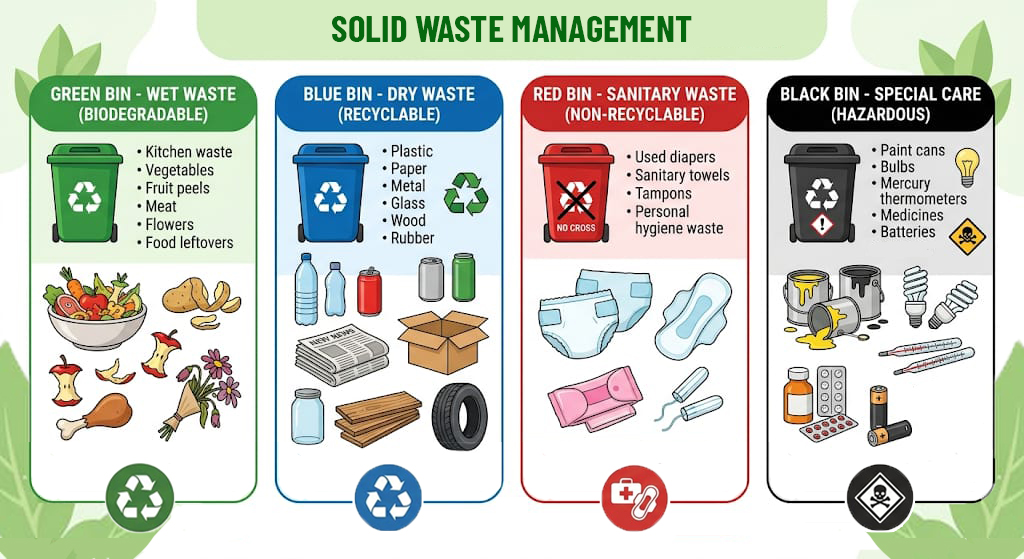
At the heart of the new framework is a simple but transformative requirement: waste must now be segregated into four streams at source—wet waste, dry waste, sanitary waste, and special care waste. This is not a minor procedural change. It is the foundation on which composting, recycling, scientific disposal, and circular economy models depend. If segregation fails, almost every downstream part of the system becomes weaker, costlier, and less efficient.
The Rules go further than household behaviour. They tighten responsibilities for bulk waste generators, require more formalised waste processing systems, strengthen digital reporting through a centralised online portal, and assign a more active role to district administrations and local bodies. Urban local bodies are required to prepare and upload a solid waste action plan, including ward-wise waste generation data, five-year projections, collection plans, and infrastructure mapping. District Collectors are expected to review local performance regularly on segregation, collection, processing, and disposal.
All this makes the SWM Rules, 2026 one of the most implementation-focused waste governance reforms India has seen in years.
But whether the Rules succeed will depend less on India’s largest metros and more on its Tier-2 and Tier-3 cities.
That is where the real challenge lies.
India’s urban growth is no longer confined to a few megacities. As per the census 2011, country has over 4,000 statutory towns and more than 7,900 total urban centres, making Tier-2 and Tier-3 cities central to the future of urban waste governance as national policy attention is increasingly turning toward Tier-II and Tier-III centres (PIB, 2016). The Union Budget 2026-27 explicitly highlights a focus on Tier II and Tier III cities, while the Economic Survey 2025-26 notes that many newer Tier-2 urban centres are growing fast and remain “urbanising, but not yet overwhelmed.” This makes them the most important space for getting waste systems right before they become unmanageable.
That opportunity is significant. Compared to the largest metros, many secondary cities still have the chance to build systems before waste volumes, land pressures, and informal dumping patterns become deeply entrenched. In theory, this should make reform easier.
In practice, it often does not.
Many Tier-2 and Tier-3 cities have improved collection coverage over the years, but segregation and processing remain inconsistent. The challenge is not just infrastructure. It is also municipal capacity. Smaller and mid-sized urban local bodies often struggle with limited technical staffing, fragmented contracts, weak monitoring, poor data systems, and inadequate financial recovery. The SWM Rules, 2026 now require them to move toward a more structured model: segregated collection, processing infrastructure, centralised reporting, formal compliance, and periodic review. That is a major operational shift.
Segregation will be the first real test.
For years, source segregation has been discussed as the starting point of good waste management, but implementation on the ground has remained patchy. The new Rules try to remove ambiguity by defining four clear streams and linking them to downstream handling systems. Wet waste is meant for decentralised processing such as composting or biomethanation. Dry waste needs sorting and recovery through registered facilities. Sanitary waste and special care waste require separate handling because of contamination and health risks. When all of this is mixed together, the value of recyclables falls, wet waste becomes harder to treat, and more material ends up being dumped or landfilled.
This is exactly why the impact on Tier-2 and Tier-3 cities will be decisive. These cities often have enough scale for the waste problem to be serious, but not always enough institutional depth to solve it smoothly. Many still operate without full material recovery systems, robust decentralised wet-waste processing, accurate bulk waste generator databases, or strong fee collection frameworks. In such places, the move from collection-focused waste management to segregation-led, processing-oriented waste management will require a redesign of everyday municipal practice, not just a new circular.
That is why the Rules matter beyond compliance.
They force a recognition that waste management is not just about lifting garbage from the roadside. It is about building a chain: household segregation, ward-level collection, bulk generator compliance, processing infrastructure, digital tracking, and environmentally sound disposal. If one link fails, the whole system weakens. For Tier-2 and Tier-3 cities, this means the next phase of urban waste reform cannot rely only on contractors and transport fleets. It must invest in systems, people, and local governance capacity.
There is also a financial angle that cannot be ignored.
In many cities, a large share of SWM spending still goes toward collection and transportation, leaving relatively less for processing and scientific disposal. That legacy structure is one reason why dumpsites continue to grow even where collection looks good on paper. The 2026 Rules change the expectation: local bodies are now expected to strengthen processing, planning, and reporting as part of regular governance. For secondary cities, that means financing models must also evolve. User fees, better contract design, state support, and targeted private participation will all matter if the Rules are to move from notification to implementation.
Another notable feature of the new framework is that it does not treat waste workers as invisible. The Rules explicitly push for the integration and recognition of waste pickers and informal waste collectors. That matters greatly in Tier-2 and Tier-3 cities, where informal recovery systems already perform a hidden but important role. Bringing them into formal waste systems can improve recovery rates, reduce leakage of recyclables, and create more just and traceable systems.
So what should cities focus on first?
The answer is not to chase large projects before fixing basic operational discipline. The immediate priorities are simpler and more foundational: ensure four-stream segregation actually reaches households and bulk generators; map ward-wise waste generation; build or strengthen dry-waste sorting and wet-waste processing systems; formalise institutional responsibilities; and create reliable digital records. This is precisely the architecture envisioned in the Rules through local solid waste action plans and stronger reporting obligations.
If this transition works, Tier-2 and Tier-3 cities can become India’s strongest examples of practical circular economy in action. If it fails, the country will continue to spend heavily on collecting waste without fully processing it.
The SWM Rules, 2026 have set a new regulatory direction. The real question now is whether India’s secondary cities can convert that legal mandate into day-to-day municipal reality.
Because in the end, segregation is not just a household act. It is a governance test. And India’s Tier-2 and Tier-3 cities are where that test will be won or lost.